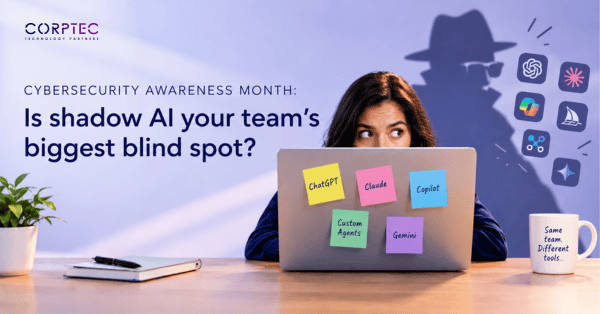
Cybersecurity Awareness Month: Exposing the Hidden Risks of Shadow AI
Cybersecurity Awareness Month is held every October to highlight the importance of cybersecurity, and public agencies are already drawing attention to the way AI is changing how cybercriminals operate. A quieter and, for many organisations, more immediate exposure sits inside the business: the way employees themselves use AI tools every day.
Generative AI has moved from experiment to daily habit faster than policy, procurement, and security controls have been able to follow. The outcome is shadow AI: the use of AI tools without employer approval, oversight, or governance. For a CTO, shadow AI is a visibility and control problem. For a CFO, it is an unbudgeted liability with measurable cost. For the board, it is a question of whether AI governance has kept pace with adoption.
In this blog, we explore the scale of the issue in Australia and globally, the specific risks it creates, the financial case for acting, and a practical AI governance framework that reduces exposure without sacrificing the productivity gains that make AI worthwhile.
Key Takeaways for Executives
- Shadow AI is already common. Research across Australia and New Zealand found that 67% of workers had used non-approved AI tools for work, compared with 57% globally.
- It carries a measurable price. IBM’s 2025 research found that breaches involving high levels of shadow AI added $670,000 to the average breach cost.
- Governance gaps are the root cause. Nearly two-thirds of breached organisations had no AI governance policy, and 97% of organisations that reported an AI-related breach lacked proper AI access controls.
- Regulatory exposure is rising. Automated decision-making transparency obligations under the Privacy Act commence on 10 December 2026.
- Prohibition is not the answer. Employees turn to unapproved tools when approval is slow or approved tools lack features; providing governed alternatives addresses the cause.
- Governance supports ROI. The objective is to direct AI use toward sanctioned, measurable, and secure channels rather than to suppress it.
What Is Shadow AI?
Shadow AI is the unapproved use of AI tools by employees or departments. It covers any AI system operating outside the visibility of IT, security, legal, and risk teams, whether or not any harm has yet occurred. The term sits within the wider discipline of AI governance: the policies, accountabilities, and controls that determine how an organisation selects, uses, and monitors AI.
How Does Shadow AI Differ from Traditional Shadow IT
Shadow IT has historically involved installing unauthorised software or connecting unapproved devices. Shadow AI usually requires nothing more than visiting a website in a browser. Sensitive information leaves the organisation as a typed prompt or an uploaded document rather than as a recognisable file transfer — hence, controls designed around email attachments and file shares may not detect it.
Where Shadow AI Hides
- Public chatbots on personal accounts: When staff paste contracts, customer records, source code, or financial data into consumer tools that sit outside any enterprise agreement.
- AI features embedded in approved platforms: When AI capabilities switched on inside existing SaaS products can operate without a fresh security review.
- Browser extensions and plugins: Security researchers have documented incidents in which employees unknowingly installed malicious AI plugins.
- AI coding assistants: When developers connect assistants to repositories without a formal assessment of where code and context are sent or stored.
- Autonomous agents and connectors: Where external AI agents can be granted access to read sensitive information, send emails, and create or delete files.
Is Shadow AI Your Biggest Security Blind Spot?
The Global Picture
IBM’s Cost of a Data Breach Report 2025 was the first edition to examine AI security and governance. It found that one in five organisations reported a breach traced to shadow AI, while only 37% had policies to locate or manage it.
On the other hand, Gartner predicts that by 2030, more than 40% of global organisations will suffer security and compliance incidents caused by unauthorised AI tools. In a related survey of cybersecurity leaders, 69% reported evidence or suspicion that employees were using prohibited public generative AI.
The Australian Picture
Australian data points in the same direction, and in several respects more strongly:
- Australia and New Zealand workers were the most likely of any surveyed region to use non-approved tools for work: 67%, against 57% globally.
- A survey of more than 1,000 Australian employees found that 87% use AI at work, 29% use a mix of approved and non-approved tools, 5% use only non-approved tools, and 12% are unsure which tools are approved. Only one in five said leadership expectations were very clear.
- Research by PagerDuty (reported in July 2026) found that 40% of respondents had uploaded customer data to public AI tools, and 28% had entered confidential company or financial information.
Why Employees Bypass Approved AI Channels
The motivation is rarely malicious. Among ANZ respondents who used non-approved tools, 49% said approval for new tools takes too long or is frequently rejected, and 48% said approved tools lacked the features they needed. Shadow AI is therefore best read as evidence of unmet demand. Where the sanctioned toolset is slower, narrower, or less capable than a free consumer alternative, usage migrates to the alternative.
Assessing The Shadow AI Risk Landscape
1. Data leakage and intellectual property loss
Shadow AI incidents expose more sensitive material than other types of data breaches. IBM found that personally identifiable information was compromised in 65% of shadow AI breaches, against a global data breach average of 53%, and intellectual property in 40% against 33%. A widely cited example is Samsung, which temporarily banned generative AI tools in 2023 after engineers pasted confidential chip designs into ChatGPT.
2. Weak access controls and absent policy
AI governance has not kept pace with AI adoption. Of the organisations that experienced an AI-related breach, 97% lacked proper AI access controls, and nearly two-thirds of breached organisations had no AI governance policy. Practically, this means that the data an AI tool can reach is often determined by individual employee decisions rather than by deliberate design.
3. Australian regulatory and legal exposure
Several Australian obligations apply directly to employee AI use:
• Privacy Act coverage: The Office of the Australian Information Commissioner (OAIC) states that the Privacy Act applies to all uses of AI involving personal information, and recommends that organisations do not enter personal information, particularly sensitive information, into publicly available generative AI tools as best practice.
• Automated decision-making transparency: From 10 December 2026, organisations covered by the Australian Privacy Principles that use computer programs to make, or substantially assist in making, decisions that could significantly affect individuals must disclose this in their privacy policies. A business cannot disclose what it cannot see, so an inventory of AI use becomes a compliance prerequisite.
• Applicable penalties: Serious or repeated interferences with privacy can attract civil penalties, reputational damage, and heightened regulatory scrutiny. Accordingly, preparing early, evaluating impacts, and embedding AI governance will be essential for mitigating risk.
• Statutory privacy tort: A statutory tort for serious invasions of privacy has been in force since 10 June 2025, creating a further route for individual claims.
4. AI-enabled attackers and credential exposure
Attackers are also using AI. IBM reported that one in six breaches involved adversaries using AI, most commonly for phishing and deepfake impersonation. Credentials remain a primary route into organisations — the Australian Cyber Security Centre reported that 42% of incidents it handled in the last financial year involved an element of stolen credentials. Employee accounts on AI platforms often hold conversation history and uploaded documents, which makes them worth protecting with the same rigour as email and file storage.
5. Reliability and technical debt
Even legitimate AI use creates cost when unmanaged. Gartner predicts that by 2030, 50% of enterprises will face delayed AI upgrades or rising maintenance costs because of unmanaged technical debt associated with generative AI. Content, code, and analysis produced by AI and adopted without review or documentation accumulate as hidden liabilities.
The Financial Case: Cost and ROI
For CFOs, the relevant question is whether the cost of AI governance is lower than the cost of its absence. The available evidence indicates that it is — particularly as the regulatory and threat environment tightens.
For instance, IBM reported average breach costs of $4.74 million where shadow AI was present, compared with $4.07 million where it was absent. The high-shadow-AI premium was $670,000.
Locally, the Australian Signals Directorate reported that the average self-reported cost of cybercrime per report for businesses rose 50% in 2025. For larger organisations, the average was $200k, an increase of 219%.
Penalty exposure under the Privacy Act scales with turnover and the benefit obtained, which means the financial downside is greatest for the largest organisations. Legal, notification, and remediation costs are incurred in addition to any penalty.
Moreover, several cost categories are less visible in a breach statistic but appear in the operating budget:
• Licence and subscription sprawl: Individual and team-level subscriptions to overlapping AI tools duplicate the spend that a consolidated enterprise agreement would reduce.
• Rework and technical debt: Unreviewed AI output requires correction later. Gartner predicts that technical debt from generative AI will raise maintenance costs for half of enterprises by 2030.
• Productivity loss from blunt controls: Blanket prohibition removes the benefit organisations are paying for. In Snowflake’s research, respondents in Australia and New Zealand expected to allocate 23% of technology budgets to AI in the coming year. Spend at that scale warrants AI governance at the same level.
An AI Governance Framework for CTOs
The Australian Government’s National AI Centre published its Guidance for AI Adoption in October 2025, setting out six essential practices:
- Decide who is accountable
- Understand impacts
- Measure and manage risks
- Share essential information
- Test and monitor systems
- Maintain human control
The guidance includes an AI policy template, an AI register template, and a screening tool, and its implementation practices align with ISO/IEC 42001 and the NIST AI Risk Management Framework. The six steps below translate those practices into an operational sequence.
Step 1: Discover
Establish what is actually in use before writing rules. We advise regular audits of shadow AI activity and the inclusion of generative AI risk evaluation in SaaS assessment processes.
• Review network, proxy, and secure web gateway logs for AI service traffic.
• Audit OAuth grants, browser extensions, and AI features enabled within existing SaaS platforms.
• Run an anonymous usage survey with a stated amnesty, so that staff disclose tools without fear of sanction.
Step 2: Classify data and define acceptable use
Create a clear AI usage policy that maps data classifications to permitted tools. Personal information, client confidential material, source code, and financial data each need an explicit rule. Align the policy with OAIC guidance on personal information and publicly available generative AI tools.
Step 3: Provide governed alternatives
Because slow approval and missing features drive shadow usage, a capable sanctioned option is the most effective control. Evaluate enterprise AI platforms against criteria — including contractual restrictions on training with customer data, retention settings, single sign-on, audit logging, and data residency.
Step 4: Enforce technical controls
• Apply data loss prevention rules that recognise prompts and uploads to AI services.
• Enforce multi-factor authentication and single sign-on on every sanctioned AI platform.
• Apply least-privilege principles to connectors and agents: grant access to specific data sources only, and review permissions regularly.
• Centralise logging so that AI activity feeds into existing security monitoring and incident response.
Step 5: Train by role
Generic awareness content has limited effect. Training should be role-specific: developers on code and secrets handling, finance and legal on confidential and personal information, executives on agent permissions and decision accountability. Employees who feel unsupported without adequate AI training may also seek opportunities elsewhere, which adds a retention dimension to the investment.
Step 6: Govern and measure
Maintain an AI register recording each tool, its owner, the data it touches, and its risk rating. Assign executive accountability, review the register on a fixed cycle, and test AI systems and their controls routinely. For organisations that use AI in decisions affecting individuals, the register also supports the December 2026 disclosure requirements.
Common Pitfalls When Enforcing An AI Governance Framework
- Relying on a blanket ban: Prohibition without an alternative pushes AI usage onto personal devices and accounts, where visibility is lowest.
- Publishing a policy without tooling: A policy that cannot be monitored or enforced does not reduce risk. With only one in five Australian employees reporting very clear leadership expectations, communication is as important as the policy itself.
- Overlooking embedded AI: Approved SaaS platforms increasingly ship with AI features, so a point-in-time vendor assessment can become outdated.
- Treating training as a one-off event: AI tools and threats change quickly, so your AI security training and governance policies need a regular review cycle.
AI Security In Australia: How Corptec Can Help
Cybersecurity Awareness Month is the appropriate time to examine the hidden risks of unmonitored AI usage that sits within the organisation rather than outside it.
The evidence is consistent: AI adoption is widespread, a substantial share of it is unsanctioned, AI governance has lagged, and the financial and regulatory consequences are increasing. The upcoming changes to the Privacy Act 1988 make an accurate inventory of AI use a practical necessity as well as good practice.
The organisations that benefit most from AI will be those that make it visible, governed, and secure, so that productivity gains are retained, and unwanted exposure is managed. That outcome depends on visibility first, followed by policy, tooling, training, and measurement.
Corptec’s AI experts can help your leadership team understand where AI is being used across the organisation, where the exposure sits, and which governance steps will deliver the greatest risk reduction and return.
As Australia’s leading IT consulting services firm with a global delivery footprint, Corptec Technology Partners offers AI consulting, advisory, and AI training services to enterprises across industries, helping them adopt AI responsibly, at scale, and in tandem with their existing software stack and established business workflows.
Interested in learning more about Corptec’s AI consulting, implementation, integration, governance, training, and intelligent automation services?
Corptec Technology Partners is a Melbourne-based IT services and AI consulting firm with a global delivery presence, helping organisations across Australia, India, the United States, the UAE, and Turkiye with technology consulting, IT managed services, automated cloud backup, cloud migration & advisory, AI consulting and AI training, technical workforce hiring, no-code test automation, and custom development and integration services.
Whether your organisation is developing an enterprise AI strategy, implementing AI solutions, integrating AI into existing platforms, orchestrating intelligent agentic workflows, automating business processes, building custom AI applications, or strengthening AI security and governance, Corptec can help you focus on business outcomes and not simply implement AI for AI’s sake.
Book a complimentary consultation with our AI expert to augment your AI journey the right way!