Nothing gets a room of IT leaders talking quite like a scrumptious spread of breakfast and good coffee first thing in the morning.
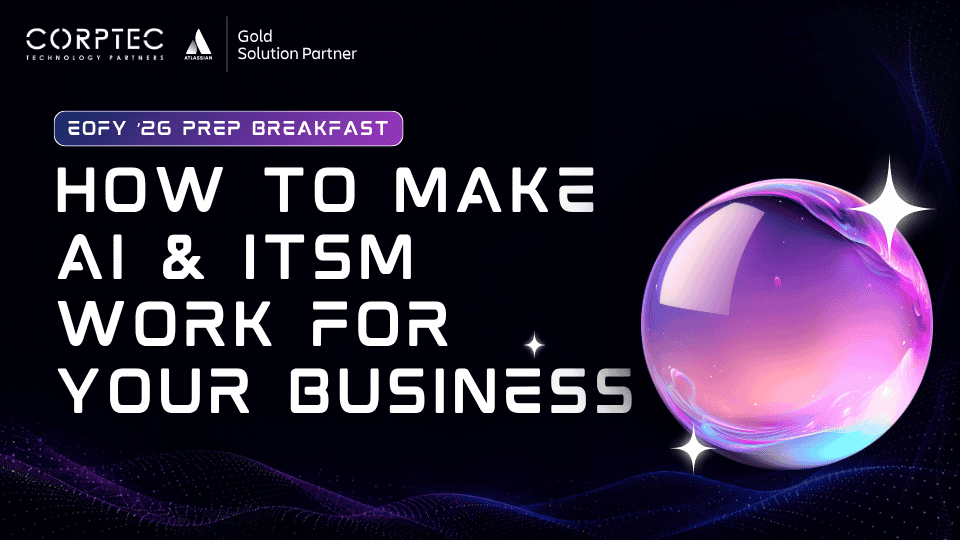
Last Tuesday, Corptec Technology Partners closed out FY’26 with real conversations around the pros and cons of reactive IT versus proactive IT. Our EOFY’26 Prep Breakfast Meet, held in partnership with Atlassian at their Melbourne office, brought together AI specialists and Atlassian experts to unpack a problem almost every business leader in the room recognised immediately: AI tools that are technically working, but somehow not moving the business forward.
Here, we present some key takeaways from the event, and what you should know before FY’27 starts in full swing.
Why AI Tools Don’t Seem To Be Actually Transforming Anything
Anthony McCallum, Corptec’s Chief AI Officer, opened the morning by asking a question that got a lot of knowing looks around the room: how many businesses have poured money into multiple SaaS platforms and specialised AI tools, only to find that the business stayed exactly where it was (even though individual productivity may have increased)?
This is an incredibly common story across companies in Australia.
- Your tickets live in Jira
- Your customer requests land in Salesforce
- Rovo AI summarises all your Jira tickets
- Agentforce classifies your Salesforce requests
- Meetings happen on Teams
- Meeting summaries lie in Loom
- Approvals crawl through Outlook
- Your knowledge base is split across Confluence and SharePoint (and neither is up to date!)
“None of these tools is the problem,” Anthony told the room. “The problem is that they’re all operating in their own little bubble. You don’t get real efficiency from adding more AI on top of a broken workflow — you get it when AI and your core business systems are actually talking to each other, so that data moves seamlessly without manual effort.”
That gap is exactly where technical debt likes to hide. IT teams end up spending their days copying, pasting, and reconciling records between systems instead of solving the problems those systems were bought to solve — and that’s before you even get to the mounting pressure of doing more with the same headcount.
Why Is AI Integration Becoming A Part of Modern IT?
So why has AI integration become such a non-negotiable part of modern IT? Anthony broke it down as follows:
- AI helps IT teams quickly detect, analyse, and summarise incidents faster and reduce downtime
- AI helps automate ticket classification, workflow triggers, system monitoring, and routine maintenance.
- AI can identify patterns proactively and predict potential failures before they happen.
- AI can analyse large volumes of operational data and provide actionable insights.
- AI-powered support can deliver faster responses, personalised service, and more accurate resolutions for end users.
- AI allows managed services teams to handle growing workloads.
He continued, “To give you a real-life example of what we do, we recently helped a US-based client integrate their front-end ticketing portal to Salesforce Service Cloud. We then used n8n (a no-code workflow automation platform) to automate the flow from Salesforce into Jira. With this integration, their support agents can now create and assign tickets in Jira for the engineering team, update status for their own activities in Salesforce, and have those changes synced back to the portal in real time.”
Anthony explained that the advantage the client gets here is that they are now able to consolidate everything into Salesforce, eliminating duplicate tickets and creating a single operational record – a single source of truth. They were also able to reduce costs by eliminating unnecessary Service Cloud licenses and ensuring that tickets were assigned in Jira – only if their engineers needed to be involved.
He presented one more local example, “A leading Australian law firm approached us with a similar concern. Their IT Ops, Support, and Dev teams were using separate tools for ticketing, reporting, email routing, and escalation, which resulted in siloed workflows and manual ITSM processes. We not only helped them implement Rovo-enabled Jira Service Management (JSM) as a superior solution to their issues but also helped integrate Confluence’s knowledge base and Jira’s project management capabilities with JSM. Now they have an increased SLA ticket resolution rate, the internal communication within IT has improved, and they get real-time customer feedback.”
Why AI Isn’t Optional in ITSM Anymore
Ishrat Cheema, Senior Atlassian Consultant at Corptec, picked up exactly where Anthony left off, and made the case that AI in IT service management has stopped being a “nice to have”.
Customer expectations have shifted, and so have employee ones. People want instant answers. Systems are expected to be always-on. And service teams are expected to deliver all of it with the same budgets and headcount they had before AI entered the picture.
“This is precisely the gap Atlassian’s Service Collection was built to close,” Ishrat explained. Powered by Rovo AI, the Service Collection brings together Jira Service Management, Customer Service Management, Assets, and a set of purpose-built AI agents into a single connected system, instead of yet another AI tool bolted awkwardly onto the stack.
“What makes it genuinely different isn’t that Rovo sits on top as an add-on,” he said. “It’s built in as the foundation — powering search, chat, and automation across the whole platform. That’s what gets you faster incident resolution and smarter triaging, without your team having to stitch a dozen systems together themselves.”
According to Ishrat, “The most important tool in the Service Collection is, of course, Jira Service Management. JSM has been specifically designed as an IT service management solution that truly connects Development, IT Ops, and Support teams on a single platform.“
And unlike other enterprise ITSM solutions in the market that are complex to use, expensive, and slow to adapt to your specific business scenario, Jira Service Management can help your team:
- Resolve incidents faster
- Prioritise the right work with full context
- Fast-track changes
- Use automation and deployment gating to reduce risk
- Gain critical insights
- And use AI and analytics to spot patterns and bottlenecks
And since JSM runs on Rovo AI under the hood, it offers features like:
- AI-generated summaries to help stakeholders quickly understand long issue threads
- Virtual service agents that provide 24/7 conversational support for common requests
- AI-driven incident clustering and recommendations to ensure patterns and trends are surfaced to prevent recurring problems
“If your organisation is already on Jira,” Ishrat pointed out, “Jira Service Management is a natural extension. The familiarity is already there. The value comes from connection and consolidation, which is offered by the broader Service Collection.”
What Atlassian Sees Coming in FY’27
Aradhana Arora, Senior Principal Partner Solutions Strategist (APAC) at Atlassian, took the room through where Atlassian sees service management heading — and made a case that’s hard to argue with once you’ve sat through the problem of disconnected tools.
“Across the region, we’re seeing ITSM stop being treated as a back-office function,” Aradhana said. “It’s becoming a strategic layer that actually connects development, operations, and customer service. Rovo AI’s job is to make that connection intelligent, so that teams get context and recommendations, not another dashboard to babysit.”
Aradhana brought some of that thinking straight from Atlassian’s own Team on Tour event in Sydney back in March, where AI as the foundation of modern teamwork, rather than a bolt-on feature, was very much the headline. Atlassian used that stage to showcase a wave of new Rovo capabilities, and the message to the room was consistent: The platform is ready. However, most organisations aren’t struggling with access to AI anymore — they’re struggling to turn that access into actual impact.
“What we heard from customers in Sydney lines up with what we’re seeing everywhere,” Aradhana told the EOFY’26 breakfast crowd. “Teams already have the licenses and the green light from leadership. What’s missing is the workflow redesign and the training to use AI with intention. That gap between having Rovo and Rovo actually changing how you work is where most of the value gets lost — and closing it is much more of a people-and-process challenge than a technology one.”
She pointed to organisations like Lendi Group, which used the shift to reorganise fragmented tools into one connected way of working that ties strategy, funding, and execution together, as a preview of where Atlassian sees every business heading in FY’27.
The Real Cost of Reactive IT
Anthony then took the room through the second half of the AI story: it’s not just service management that is evolving to include AI — modern IT managed services are also evolving.
However, ask most businesses what IT managed services means, and you’ll get a familiar answer — an IT vendor who helps with troubleshooting now and then, does some monthly patching, and checks in once a quarter to make sure everything’s alright.
That’s not managed services — that’s reactive IT. And reactive IT is expensive, because by the time you’re calling your IT service provider, something has already gone wrong.
Anthony remarked, “Real IT managed services looks different. It’s a provider who notices something is about to fail and fixes it before it does. Who resolves access risks proactively, ahead of a security audit rather than in response to one. Who validates and tests backup integrity as a matter of routine, not as an afterthought. And who’s continuously optimising your cloud infrastructure to cut waste and improve performance, rather than reviewing it once a year.”
At this point, a CTO from the audience asked, “This all sounds nice, but we already have a sizeable internal IT team. We don’t need to rely on a managed services partner to manage our cloud, ITSM, or AI environment.”
Anthony had his answer ready: “That’s the point! An IT managed services provider is not meant to replace a strong internal IT team. They are meant to amplify it.”
According to him, the technology ecosystem today is quite complicated.
Applications are spread across multiple cloud platforms. People work from anywhere. Security threats keep evolving. And licensing, compliance, backup integrity, identity access, and cloud cost governance all need continuous oversight that most internal teams simply don’t have the hours for — they’re already stretched thin supporting users, running projects, and keeping systems stable all at once — often without the deep, specialist expertise needed across every one of those areas.
Bringing in a managed services partner to absorb the repetitive, reactive, backend work is what frees an internal IT team up to focus on strategic outcomes instead.
Anthony walked the guests through what that looks like in practice at Corptec. As Atlassian’s Gold Solution & Implementation Partner, Corptec monitors and maintains clients’ Atlassian environments round the clock — Jira, Confluence, JSM, Trello, and everything connected to them.
When an employee leaves, or a new one joins, it’s not just onboarding and offboarding that gets handled; Corptec runs an audit to catch redundant or inactive users and flags product features clients are paying for but not actually using. They then run a full licensing and instance cleanup off the back of it. If a Jira project workflow isn’t configured as well as it could be, that gets identified and optimised too. And when something significant is coming down the line — like the Data Centre End of Life or the Opsgenie retirement announced earlier this financial year — clients are kept informed well ahead of time, with a clear view of what their next move should be.
Because Corptec is also a technology partner for Salesforce, Microsoft, AWS, CrowdStrike, Opkey, and HYCU, among others, that oversight doesn’t stop at Atlassian. It’s genuinely a 360-degree technology partner — spanning SaaS implementation, AI integration, automated cloud backup, cloud migration advisory, technical workforce hiring, AI security training, test automation, and custom development. For clients juggling a stack of different SaaS tools, that means one team managing the entire environment as a single connected architecture, rather than a different vendor for every platform. It also means someone’s actually keeping an eye on the billing — reviewing subscriptions across the stack, flagging renewals before they auto-charge, and chasing down the costs that quietly compound over months without anyone noticing.
And when a genuine crisis does hit — think the CrowdStrike outage two years ago, or last September’s Optus failure — that’s exactly when a modern AI-led managed services partner proves their real worth.
Anthony remarked, “Some of our clients have had incidents where their employees walked in at 8 a.m. on a Monday morning, all ready to start the new week – only to find that their applications were not loading properly or that there had been a system crash. Of course, they had a capable IT team, but they had their own priorities to work on, and were unable to cope with the tickets flooding their workspace.”
He continued, “Corptec’s team steps in when a crisis like this occurs to manage the situation in the best way possible. We run diagnostics, do an investigation, review system logs – and in the example above, we finally traced the issue to a hardware fault.
And that’s how we help your IT teams function at their best. By doing everything that does not need their direct involvement, by working quietly in the back end, and trying our best to make sure we catch alerts before they disrupt your business.”
EOFY’26 Prep: How to Make AI & IT Work for Your Business
Biret Agirtan, Managing Director at Corptec, closed the morning discussion with a reflection on why topics like this matter — not just for enterprises, but for anyone looking to future-proof their evolving tech landscape.
“EOFY is when businesses are already asking themselves hard questions about their technology spend,” Biret said. “It’s the one time of year when almost every business in Australia naturally pauses to review performance, evaluate costs, and make decisions that shape the next 12 months. And yet, plenty of businesses will still auto-renew the same IT agreements without checking whether they can actually handle rising operational complexity, new security threats, or the cost pressure heading into FY’27.
Our job at Corptec isn’t to add to the noise. We help you analyse whether your technology foundation is solid enough to carry you into the new year. And we tell you bluntly — if you are not seeing transformational business outcomes, you need the courage to pivot.”
Regardless of where you are in your AI transformation journey, Corptec can help you ensure that your SaaS, cloud, and AI environment is genuinely working as one connected system. We can help you keep your SaaS and Cloud environment resilient and scalable in FY’27 and beyond, by bringing in AI and automation, along with solid data security and governance.
Eager to explore how you can move beyond reactive ITSM to a model where your technology partner is as invested as you are? Book a free discovery session with our AI integration expert today!
As Australia’s leading Atlassian Gold Solution & Implementation Partner since 2018, Corptec Technology Partners helps businesses unlock the full potential of Atlassian tools with tailored workflows, Atlassian product implementations, automation, and AI-enabled solutions using Atlassian Intelligence and ROVO AI. With HYCU as our backup partner, we ensure secure, compliant, and reliable data recovery across Atlassian applications, including Jira, Confluence, JSM, and Trello.
We are also the chosen technology partner for 30+ technology giants, including Salesforce, HubSpot, Microsoft, CrowdStrike, AWS, Cisco, and Opkey, among others. With 100+ clients across the globe, served by a dynamic team of 90+ certified on-shore and off-shore technical experts, we have delivered over 500 projects till date, ranging from SaaS product implementations, AI consulting, and custom development to cloud migration and advisory, AI security training, IT managed services, and niche technical workforce hiring.
Get in touch with our expert today to learn how we can help you build your IT and AI strategy for FY’27!