Running an AI pilot is easy. Scaling AI so it delivers lasting value — safely — is where most organisations come unstuck.
Most organisations have already experimented with AI by now. Their employees regularly use Generative AI tools. They have teams that have built a proof of concept. Technology giants like Atlassian, Salesforce, HubSpot, and Microsoft have added AI-powered features to the software they already use. Many of these experiments look promising. Far fewer become reliable services that people across the organisation actually depend on.
The numbers below tell the story:
- At least 30% of generative AI projects were predicted to be abandoned after proof of concept by the end of 2025. Gartner pointed to poor data quality, inadequate risk controls, escalating costs and unclear business value as the culprits.
- 60% of AI projects without AI-ready data are predicted to be abandoned through 2026. Gartner also found that 63% of organisations either lack the right data management practices for AI or aren’t sure they have them.
- 42% of companies abandoned most of their AI initiatives in 2025, up from 17% the year before, according to S&P Global Market Intelligence.
- Over 40% of agentic AI projects are predicted to be cancelled by the end of 2027. Gartner cites escalating costs, unclear value and inadequate risk controls.
Notice the pattern? Almost none of these failures are about the model. They’re about everything around it: the data, the skills, the infrastructure, the governance, and the way people adopt change.
For government agencies, not-for-profit organisations, law firms, financial institutions, healthcare providers, and universities, the stakes are higher still. You’re handling sensitive data, answering to regulators and boards, and earning the trust of the people you serve.
Which is why we have asked our AI experts to compile a 2027 AI Readiness Checklist for our client organisations that already have pilots or early AI use under way and are deciding what to scale next, and how.
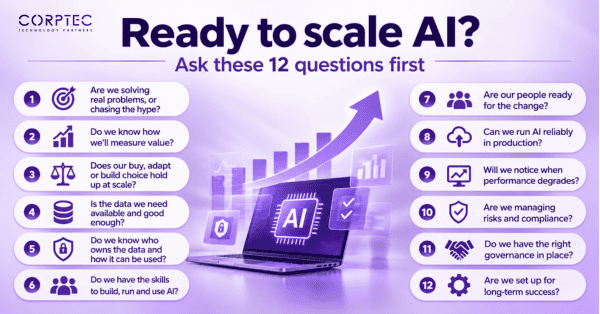
2027 AI Readiness Checklist for Organisations Looking to Scale AI
Part 1: Strategy and Value: Are you solving real problems or chasing the hype?
- Do you know which AI pilots deserve to scale? Scaling everything that looks promising isn’t a strategy. Organisations likely to get value from scaling AI focus on pilots that deliver a better return on investment or solve a specific business problem with evidence that they work (for example, cutting time spent on routine enquiries, speeding up document review, or improving forecast accuracy). The rest get revised, parked, or stopped.
Ready to scale AI looks like a short, prioritised list of the pilots and use cases worth scaling, tied to measurable outcomes, and owned by business leaders and key stakeholders alike – not just IT. - Do you know how you’ll measure value from AI initiatives? AI pilots often succeed on enthusiasm. Scaling AI, however, needs evidence. All the decision-makers need to agree up front on how you’ll measure benefit from AI — whether that’s hours saved, errors reduced, revenue gained, or client and employee satisfaction improved.
Ready to scale AI looks like a baseline and target for every use case, and a plan to measure AI ROI after go-live. - Does your buy, adopt, or build AI choice hold up at scale? A choice that made sense for an AI pilot can look very different when the users are ten times more. AI features in products you already own (such as Atlassian Rovo, Salesforce Agentforce, or Microsoft Copilot) may be the cheapest to scale. A general AI model adapted to your unique business context brings ongoing tuning and running costs. A bespoke AI solution brings long-term support and skill demands. Each path carries different costs, lock-in, and risks as volumes grow.
Ready to scale AI looks like a clear sourcing decision for each use case, tested against scaled costs, support needs, and risk.
Part 2: Data: Is your data an asset or a liability?
- Is the data you need available and good enough? AI runs on data. If yours is incomplete, inconsistent, locked in silos, or poorly understood, even the most sophisticated model will struggle.
You’re ready to scale AI when, for each priority use case, the data has been identified, quality-checked, and made accessible under clear rules. - Do you know who owns the data and how it can be used? AI raises hard questions about ownership, consent, privacy, and intellectual property. Who can approve any given AI use case? Is customer or employee personal information involved? Can it be shared with a supplier? For organisations handling client, patient, student, or citizen records, this is non-negotiable.
You’re ready to scale AI when you can name data owners, cite clear policies on permitted use, and conduct privacy reviews for any use involving personal information.
Part 3: People and Skills: Have you ensured consistent AI adoption?
- Do you have the skills to build, run, and use AI? Scaling AI takes a blend of skills: executives who understand the business problem, teams with data and engineering capability, and managers with the judgement to decide whether AI outputs can be trusted. Everyday users need to know how to use AI well and spot when their AI agents take the wrong action.
You’re ready to scale AI when you have an honest view of your organisation’s AI skill gaps and a plan to close them through AI security training, AI talent hiring, or through AI consulting partners. - Are your people ready for AI workflows to be a part of their daily tasks? AI changes how people work. Some will welcome it. Others will worry about their jobs or distrust the outputs. Ignoring the human side is one of the most common reasons AI projects fail to deliver.
You’re ready to scale AI when you can instil honest communication about what AI will or won’t do, involve affected staff in the design, and provide real support for new ways of working.
Part 4: Technology and Operations: Have you vetted AI demos against actual business use cases?
- Can you run AI reliably in production? A model on a data scientist’s laptop is a very different thing from a service used by thousands of people every day. Production AI needs dependable deployment, monitoring, version control, and the ability to roll back when something goes wrong.
Ready to scale AI looks like repeatable pipelines for deploying and updating models, plus monitoring for performance, cost, and errors. - Will you notice when the performance of AI models degrades? AI models drift as data and circumstances change. Outputs that were accurate at launch can slowly become less reliable, often without anyone noticing. In a legal, financial, or healthcare setting, that’s a serious risk.
Ready to scale AI looks like ongoing monitoring of accuracy and data quality, clear thresholds, and owners who act when those thresholds are breached.
Part 5: AI Governance and Trust: Can you prove your AI is safe, fair, and accountable?
- Is your AI governance proportionate to possible risks from AI? Summarising internal meeting notes is a very different proposition from screening job applicants or triaging client requests. AI data security and governance should be light for low-risk uses and thorough for high-risk ones.
You’re ready to scale AI when you have an inventory of AI uses, a simple risk-tiering approach, and named owners for higher-risk uses. - Can you explain and challenge AI-supported decisions? Where AI affects customers, clients, patients, students, or staff, people may need to understand how a decision was reached and have a way to challenge it. Regulators increasingly expect this for significant decisions.
You’re ready to scale AI when you ensure human oversight for significant decisions, provide a way for people to query outcomes, and document how each system works and was tested. - Are your suppliers’ AI practices acceptable? Much of your AI will arrive through vendors, and the number of AI-enabled products in your environment will only grow as you scale. Do you know how their AI features use your data, whether your data trains their models, and how they test their outputs?
You’re ready to scale AI when you ensure that AI questions are built into procurement and contract reviews as standard.
2027 AI Readiness Checklist: 6 Questions Every Executive Must Answer Before Scaling AI
The 12 questions above test your foundations. The 6 below test your leadership. They’re the conversations executive teams and boards tend to avoid, and they’re often where AI value quietly leaks away. If an AI initiative can’t explain why this, why now, and for whom, it’s probably what we call “AI pilot theatre” — plenty of visible activity, and no problem actually being solved.
- Does your AI ambition match what you’re prepared to fund, staff, and govern at scale? There’s a big difference between “AI in every workflow by next quarter” and “AI carefully embedded in two or three high-leverage processes.” Both can be right, but they mean very different budgets, risks, and timelines. Without a shared ambition, every team scales to its own. Marketing experiments, finance hedges, and IT builds for a future the board hasn’t agreed to fund.
Ready to scale AI looks like a stated position (cautious, opportunistic, or AI-first) that acts as the filter for what gets scaled and what doesn’t, backed by real funding and people.
[Red flag]: Since AI is a priority, every team is exploring it. - Are you spending more on AI tools than on the foundations underneath them? Organisations getting the most from AI tend to invest more in data, governance, and people than in the platforms on top. The ones stuck often have the opposite shape. New platforms are easy to approve because they demo well. Metadata, data quality, and training don’t. But the foundation is what makes the platform worth buying.
Ready to scale AI looks like a visible split between foundation spend and tool spend; no new tool gets funded without a foundation plan attached.
[Red flag]: We’ve licensed three new platforms. We can bother sorting the data work later. - Is AI governance a priority? Who in your company owns it? AI governance that turns up at the end as a compliance review will always feel like friction. AI governance that’s been built in from the first sprint is what makes AI safe enough to move out of the sandbox and into real client-facing work. It also needs a person, not just a committee. You need to decide who is accountable if an AI agent makes a costly decision.
You’re ready to scale AI when AI governance is part of every use case from day one, with a named business owner, technical owner, and data steward for each.
[Red flag]: All we need is a monthly working group. Day-to-day oversight can be managed by whoever is closest to the system. - Does your enterprise have one shared source of business meaning? Ask three departments what “client,” “active user”, or “revenue” means, and you’ll likely get three answers. People can live with that. AI can’t. Without shared definitions (a business glossary or semantic layer), an AI model has to guess at meaning. Sometimes it guesses well. Sometimes it confidently makes things up.
Ready to scale AI looks like one authoritative, business-owned set of definitions that AI systems are required to use.
[Red flag]: A glossary doesn’t matter; we will align them when it becomes a problem. - Where will humans lead, and where will they review? “Human in the loop” sounds reassuring, but nobody can meaningfully review thousands of low-stakes decisions a day. Decide use case by use case. Either AI assists a human who makes the call (think eligibility decisions, legal advice, or clinical judgement), or AI acts and humans handle the exceptions (think document sorting or routine triage). Each AI workflow needs its own oversight, training, and audit trail.
You’re ready to scale AI when every use case is classified into one mode or the other.
[Red flag]: We keep a human in the loop everywhere, just to be safe. - What happens to your people on the other side of AI adoption? AI changes what jobs look like, which skills are valued, and who makes decisions. Organisations that are upfront about this invest in reskilling. They design hybrid teams where AI takes the repetitive work, and people take the judgement calls. Those that aren’t tend to discover the consequences in retention numbers and trust scores.
You’re ready to scale AI when you have leaders who can describe what affected roles will look like in 12-36 months, and can explain what support is in place to get there.
[Red flag]: We’ll deal with workforce impact when we have to.
2027 AI Readiness Checklist: 7 Practical Tips to Move from Pilot to Production
AI readiness and adoption aren’t the same thing. AI readiness is what you put in place before AI expands beyond the pilot, such as clean data, clear governance, the right skills, and a workforce willing to change. AI adoption is whether people actually use the tools consistently, in their daily work. Skip the first, and the second stalls the moment your AI pilot is brought into real business workflows. These seven checks help you close that gap.
- Does your AI pilot have a board-level metric and an executive sponsor? When AI pilots are linked to a number the leadership already prioritises — whether that’s cost, revenue, turnaround time, or service quality — they are far easier to defend when priorities shift and when the budget to scale is requested. AI pilots without a named metric and an executive sponsor are the ones most likely to stall between proof of concept and rollout. They should also sit within a documented transformation roadmap, not float alongside it.
You’re ready to scale AI when every use case slated to scale has a board-level metric, a named executive sponsor, and a place in the roadmap. - Will your systems cope when AI scales? AI that works for 20 pilot users can buckle under 2,000. Test this before you scale, not halfway through. Can teams pull data across systems without manual exports? Are your core platforms, such as your CRM, case management, or finance systems, open to integration through APIs? Can your environment handle the speed, volume, and cost the use case demands at full scale? Will your security controls still hold?
You’re ready to scale AI when infrastructure and integration requirements for scaled AI use are documented and priced before rollout expands. - Do you have the skills to run and support AI at scale, mapped by role? Organisation-wide confidence surveys tell you how people feel, not who can evaluate an AI output, monitor a model, or spot a policy risk. As AI use expands, a lawyer, a case manager, a data engineer, or a security lead would each need different capabilities. Demand for role-based and skill-based AI training will also grow.
You’re ready to scale AI when you have role-specific learning paths tied to the use cases you’re scaling next, plus the capacity to support them. - Do you have a change playbook for each AI rollout? Before launch, be ready to answer three questions:
– Which tasks will AI support, speed up, or replace?
– How should managers coach teams, review AI-assisted work, and handle exceptions?
– Where can staff report friction or missing guidance?
When those questions are still open at go-live, even useful tools drift into side experiments.
You’re ready to scale AI when you have the answers written down, communicated before rollout, and revisited afterwards. - Did your pilots produce a clear decision? An AI pilot that drifts into open-ended experimenting never produces evidence anyone can act on. Good pilots have one owner, one success metric, a fixed timeline, and a pre-agreed threshold for what happens next: whether that’s scaling AI, revising your AI strategy, or completely shutting down the initiative.
You’re ready to scale AI when every AI pilot has a verdict against a bar that was set before it began, and those that haven’t earned scaling are revised or stopped. - Will your risk framework hold up as AI use expands? Frameworks such as the NIST AI Risk Management Framework (Govern, Map, Measure, Manage) give you a practical structure. AI governance is the best place to start: policies, training, and accountability. As AI use grows, more people, data, and decisions will be exposed, so you need to answer three plain questions:
– Who approves an AI model for deployment?
– Who reviews it for bias?
– Who responds when something goes wrong?
You’re ready to scale AI when you can confidently name people for each, and have already rehearsed your organisation’s AI incident response. - Are you measuring AI readiness continuously, or only occasionally? A one-off AI readiness assessment goes stale quickly. Track three things together:
– Skills progression and retention: Are people moving from AI awareness to production skills?
– AI workflow integration: Is AI being used in daily work, and not just in workshops?
– Business impact: Can you tie it to speed, accuracy, or revenue?
Training completion tells you what people did. Business results tell you whether it worked. And be wary of celebrating model accuracy on its own if it isn’t connected to a business outcome.
You’re ready to scale AI when you’re able to conduct a regular review that looks at all three together, ahead of each budget cycle.
Things to Keep In Mind While Using An AI Readiness Checklist
- Prioritise the blockers. Gaps in data, production operations, and governance are the ones that most often stop AI from scaling. Tackle these first for the use cases that matter the most.
- Don’t wait for perfect. You don’t need all 12 in place before you scale AI. Start with low-risk, high-value use cases that suit your current foundations, and build capability as you go. The checklist exists to stop you from scaling AI when your current software, employee, data, or workflow foundations can’t support it.
- Before implementing or scaling AI, give it an owner. A senior leader should own the overall approach; there should be business owners for each use case and ample support from IT, data, risk, and HR.
- Be realistic about timing. Organisations with strong data foundations may scale selected AI use cases within months. Those with fragmented data and limited skills may need a year or more of groundwork. Knowing which camp you’re in is half the battle.
[Related Reading: 8 Questions You Should Ask Before Funding Another AI Pilot In FY’27]
How Corptec Can Help You Scale AI in 2027 & Beyond
If your company has already experimented with AI in some form or another, the goal for 2027 shouldn’t be to have more AI pilots. It should be to have AI that works, is trusted, and delivers measurable value.
This is where Corptec can help you.
Corptec’s AI experts can help your leadership team understand where AI is being used across the organisation, where you are wasting money on unprofitable AI pilots, and how to scale AI in a way that will deliver the greatest risk reduction and return.
As Australia’s leading IT consulting services firm with a global delivery footprint, Corptec Technology Partners offers AI consulting, advisory, AI governance, implementation, integration, talent hiring, and AI training services to enterprises across industries. We help you adopt AI responsibly, at scale, and in tandem with your existing software stack and established business workflows.
Our AI consultants have specific experience working with decision-makers across government, not-for-profit, legal, finance, manufacturing, healthcare, and education to:
- Assess where you really stand in your journey to adopt, implement, or scale AI
- Prioritise the use cases with the strongest value and the lowest risk
- Build and integrate AI securely into the platforms and workflows you already use
- Govern and secure AI, and upskill your teams to use it responsibly
Additionally, Corptec’s expertise spans technology solutions (such as Atlassian, Salesforce, & Microsoft), IT managed services, cloud migration & disaster recovery, custom development and integration, software test automation, and niche tech hiring. That means we can help you get your data, platforms, security, and people ready for AI as one joined-up effort, rather than leaving you with a pilot that can’t leave the lab.
If you’re looking for a professional opinion before scaling AI in FY’27, please get in touch with our AI expert for a no-commitment-required discovery session. We’ll walk through your checklist results, identify your biggest blockers, and map out a practical path to scaling AI with confidence.